Tuesday, April 16, 2013

Say Cheese!!

Life is all about living the moments. With due respect to all those who find it funny to see me always with a camera, here’s me reliving it with all you, the best of times spent with Sancta Marians.


Grade 1  Diwali presentation "WOW"


When you are happy and you know.....


In love with this one:) SMILE


Now this one is not saying much of cheese:)

Why kids should have all the fun??

V as Victory  but for what??? Let me check it with them. 


Spirited to fly high !

Just for Gags!

Its a BA- Balancing the apple;-) approach

YO super cool play time .

Night Out but who'll sleep??

Never too busy to love your life<3


After a busy day"Ek garam chai ki pyali"


Poetry enactment in action in G4

Kaai po che......

All set for the run..

I just love them- my inspiration and motivation to keep going .


Bubbly Birdie 


Emperor Yedi


Saying Bye to Spoorthi:( G1

Learning Festivals

Life offers all of us with good and bad times the only difference lies in what we want to relive and move on with. I am no philosopher to preach anything here but the bliss of life will surely be yours once you decide to live with happiness and bury the sadness.
There is no shortcut to happiness but there is a little key to this treasure which can be shared by just smiling once and capturing that moment to relive and rejoice forever.

Wednesday, April 10, 2013

Treasure hunt

As a part of our social science topic - directions, we have organised a treasure hunt for our 2nd graders. You see, in directions, we learned about north and south, east and west. Most of the children were actually able to name the direction before we even started the topic anyway but how well did they know the concept and could they apply it in the real life? After all, being a Cambridge school applying the knowledge is like the whole point.
.
Well, to asses what those names of directions meant to them, we went outside. All the children knew about the four cardinal directions but only one of them was actually able to demonstrate it outside, with the help of the sun and our body shadow. I was happy - it meant i can actually teach them something! :)

So, we went back to the basics. We made a compass in the class from scratch! Using a petri dish that we got from our bio lab, a floating foamy circle shape we borrowed from the math department, a needle and some water for our circle to float and of course the physics lab supplied us with magnets.
Getting the "wow" effect from kids is always the best and trust me, they were mesmerized! Such a simple, inexpensive device but so magical :) Most importantly, they made it them self. Hands on, that is what counts.

After directions were clear and kids were able to truly understand how compass works (by saying "truly", i of course mean age appropriate explanations!) we put it to the test by reading simple maps. It worked! Marking compass rose on the map with directions was always the first step. Everything else fell into place after that.

A crown event to put our knowledge to work was the treasure hunt. Majority of clues were related to the directions. Kids had fun, they applied their knowledge and learned a lot in the process!

All you need for a treasure hunt is good imagination to make the clues.                            
Treasure hunts are an excellent tool to teach children patience, team work, focused reading and following instructions. Teams should be small (3 to 5 children). No matter what the topic is you can make the clues accordingly. The level of difficulties can be easily adjusted to fit every grade. For best learning experience it is absolutely beneficial to have some sort of analysis after wards where all the kids share what went great, what not so great and how could they improve. In such cases treasure hunts can be a very empowering learning tool while also being super fun!

Darsh reading the clue number 2 to his team mates.
Jagannath was quickly reminded by all to read the clue out loud so everyone can hear it.

Tuesday, April 9, 2013

Aesop's Fables

I recently happened to get hands on Aesop's fables for my son. It was fun to read them and he enjoyed them immensely. Then I saw the commonness in all of the stories which had mostly animals of all kinds as characters to impart moral education.

Intrigued, I searched the meaning of a FABLE and found it was pretty close to the above mentioned observation. I found the following meaning of Fable:
A fable is a succinct story, in prose or verse, that features animals, plants, inanimate objects, or forces of nature which are anthropomorphized (given human qualities), and that illustrates a moral lesson (a "moral"), which may at the end be expressed explicitly in a pithy maxim.
Characteristics of a fable
* Its purpose is to impart a lesson or value, or to give sage advice.

* It also provide opportunities to laugh at human folly, when they supply examples of behaviors to be avoided rather than emulated.

* It frequently have as their central characters animals that are given anthropomorphic characteristics such as the ability to reason and speak.

Who is Aesop?

Coming to Aesop's Fables, we must answer the question, who is/was Aesop?
Aesop was a slave and a story-teller in ancient Greece during 5th century BC.
So these fables were told by Aesop and known as the Aesop's Fables.

Although, there is a lot of doubt about his existence, yet many of the stories do throw you into a pensive mood. Guess, after reading the stories I felt the emphasis must be laid upon the morals that can be derived from these stories.

I wonder why we always relate moral stories only children. I think even adults need these stories to assist in self-introspection! After all, its the adults who have to derive these morals from the stories and explain to the children!

Albeit, all stories are worth reading and contemplating upon, yet I chose a few of them to post here. Its not that there are no such stories elsewhere, but these being full of fancy animals and all, may appeal better to the children.

STORY - 1

The man and the lion


A man and a lion traveled together through the forest. They soon began to boast of their respective superiority to each other in strength and prowess. As they were disputing, they passed a statue carved in stone, which represented "A lion strangled by a man." The traveler pointed to it and said: "See there! How strong we are, and how we prevail over even the king of beasts." The Lion replied: "This statue was made by one of you men. If we lions knew how to erect statues, you would see the Man placed under the paw of the Lion."

Moral
One story is good, till another is told.


STORY - 2

The dog in the manger


A dog lay in a manger, and by his growling and snapping prevented the oxen from eating the hay which had been placed for them. "What a selfish Dog!" said one of them to his companions; "he cannot eat the hay himself, and yet refuses to allow those who can eat."

Moral
It is in the last statement itself!

STORY - 3

The Miser


A MISER sold all that he had and bought a lump of gold, which he buried in a hole in the ground by the side of an old wall and went to look at daily. One of his workmen observed his frequent visits to the spot and decided to watch his movements. He soon discovered the secret of the hidden treasure, and digging down, came to the lump of gold, and stole it. The Miser, on his next visit, found the hole empty and began to tear his hair and to make loud lamentations. A neighbor, seeing him overcome with grief and learning the cause, said, "Pray do not grieve so; but go and take a stone, and place it in the hole, and fancy that the gold is still lying there. It will do you quite the same service; for when the gold was there, you had it not, as you did not make the slightest use of it."

Moral
In the last statement itself!!

Do you still think that these stories should be restricted only to children when we find the adults indulging in such behavior. Learning process is never bound by age and life is a continual learning process.

It is good time for readers to reflect and even better, contribute to the blog too!! :)

Friday, April 5, 2013

Irukandji Jellyfish

Sometime ago, I watched a documentary on Irukandji Jellyfish (I.J.F.) on Animal Planet. It was intriguing to watch that a sting by an I.J.F. can prove fatal considering its small size. It was difficult to comprehend as to how can such a small creature be so dangerous. It is just 1.2 cm by 2.5 cm body while the length of the contractible tentacles may vary from 5 cm to 1 m.


These jellyfish are mostly found in Australia. The jellyfish are named after the Yirrganydji people (aka Irukandji), who are a group of Australian aborigines.

It is found that these jellyfish sting from the tip of their stingers. It causes severe pain and the venom starts taking effect after 15-20 minutes. If timely cure is provided within that time, then the sting is not fatal. But there are reports where few humans have died because of Irukandji sting!

Imagine such a small creature killing a fully grown human being! Wonders of nature or what may I say!!


(Information from wikipedia)

Wednesday, March 13, 2013

SPORTS BONANZA @ Sancta Maria International School

An evening of  fun, run and sweat a ton!

 Spectators parents....

 And the little kids lined up with Coach Rghunath  
(from KOOH sports, a Mumbai based Sports Organisation)

 A fence of teachers who stood as a boundary!

 Now they jump the ladder! (all through musical cues!)

 Who's under the colourful parachute? 
(a game of co-ordination and colour recognition)

 The elder kids relay! 
(The Get-Athletic programme by KOOH Sports for ages 6-10)

 A strong parents' team lined up...

 Followed by the staff.. Oh wait! there are a few kids too! 
Not to forget the 'injured brave soldier' Urska!

 In action.....

 As Mr.Singh  maneuvers the ball.

Eventually, the scores... Who won?... The parents!

Tuesday, March 5, 2013

Education Symposium @ Sancta Maria

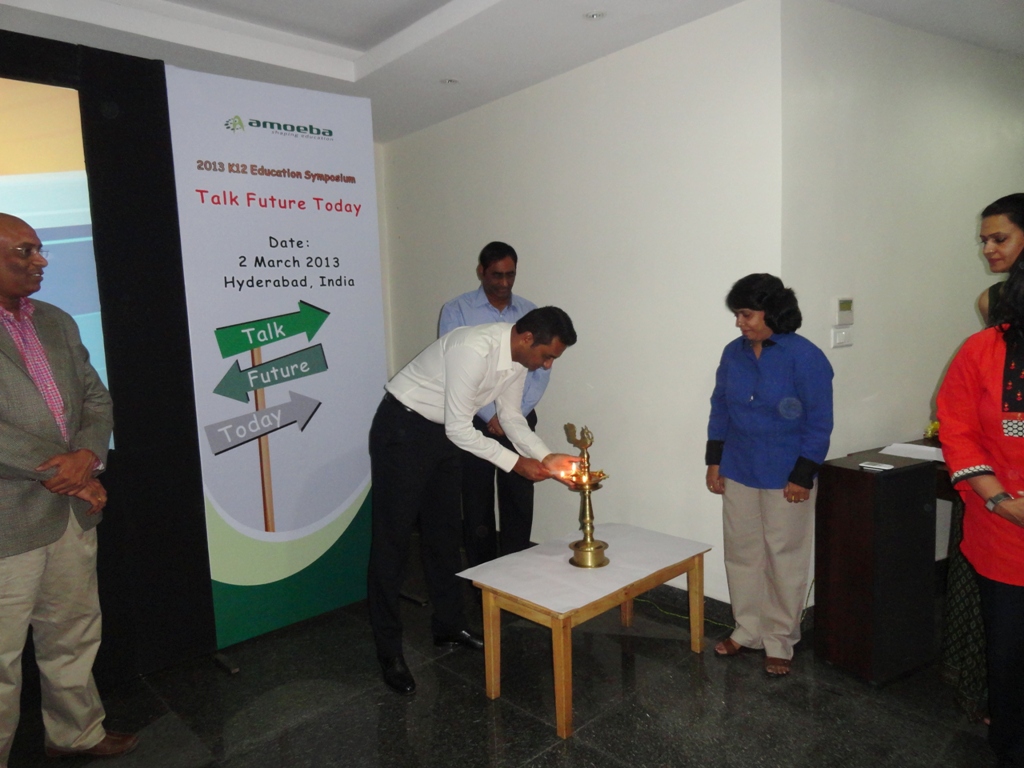
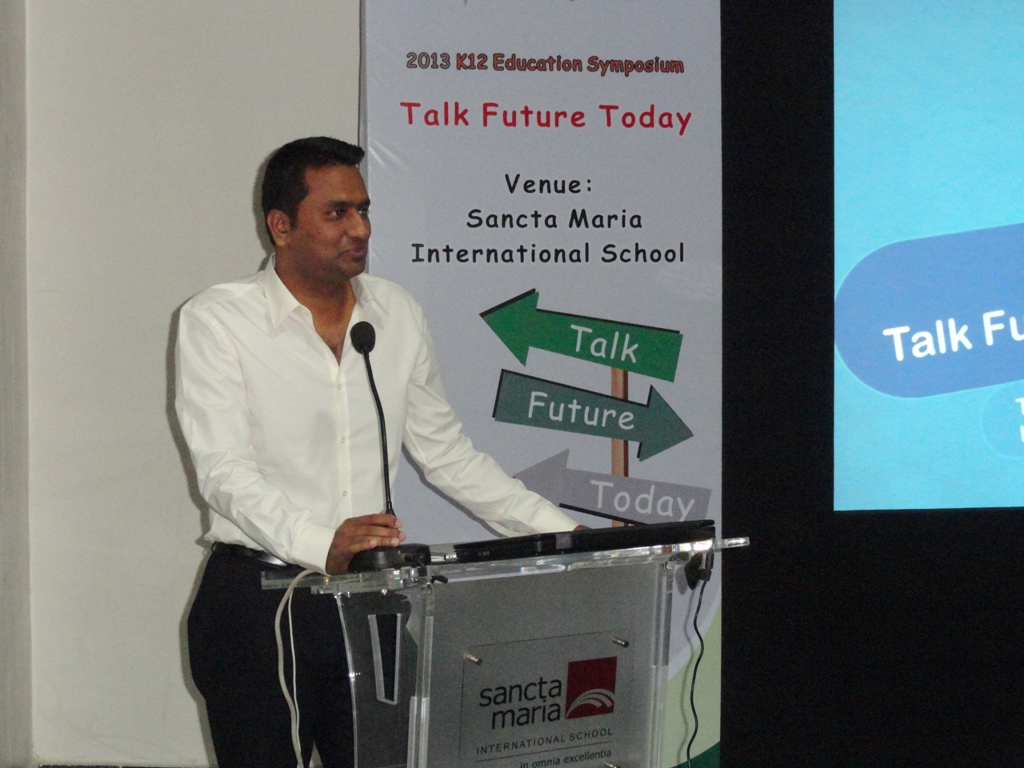
Sancta Maria International School co-hosted 2013 K12 Education Symposium – TALK FUTURE TODAY along with Amoeba Education. The symposium aimed at providing a knowledge platform for K12 education experts, share  and explore the future trends in education under the background of globalization. The theme of this sumposium was “Talk Future Today.” It was supported by educators, innovators and mentors like Ms. Geeta Narayan, the founder Director of the Shrishti School of Art Design and Technology and its sister institution, the Mallya Aditi International School and Mr.Hari Krishna. Some very interesting videos shared by these eminent educators were the highlight of the event and inspiring suggestions for the teachers which could really be useful for “MODERN DAY” learning was another added brightness.Keen participation from Principals, Directors and Teachers from schools of the twin cities was seen.

 Education Symposium K12 - Talk Future Today

 Inauguration of the ceremony by Mr. M. Reddy

 Mr. M. Reddy welcoming the guests

 Ms. Geeta Narayan addressing the gathering

Engrossed audience

Sunday, March 3, 2013

Knowing our green friends- Plants


Children are learning about the different types of plants!

The topic of the month for PP2 children in February 2013 was “Plants”. For them, it was a very interesting topic in many aspects. The reason for choosing this topic was, for the children to understand the importance of plants and their relationship to how plants aid our everyday environment. When we started the initial topic discussion with a video presentation of a ‘tiny seed’ and later explained to them how each seed ‘has a tiny little plant inside’, they were awestruck.
Plant sprouts out from the seed! 
WOW! Such  big leaves.
To ensure they understood the entire germination process, each child sowed seeds, watered them and exposed them to sunlight every day (for 2 weeks) for a better understanding of how plants make their food (concept of photosynthesis) and grow big. To aid their understanding further, the difficult photosynthesis process was demonstrated to them with the help of a simple kitchen experiment. 
Exploring the shrubs!
Another learning experience for them was that plants are of many types, e.g. trees, herbs, creepers, shrubs, climbers etc. with different physical characteristics. They learnt this by doing a nature walk and actually experimenting through touch and feel. To aid them in learning faster about plants, we organized several hands-on activities, such as art & craft, games, songs, storytelling, picture stories narration, videos presentations etc.


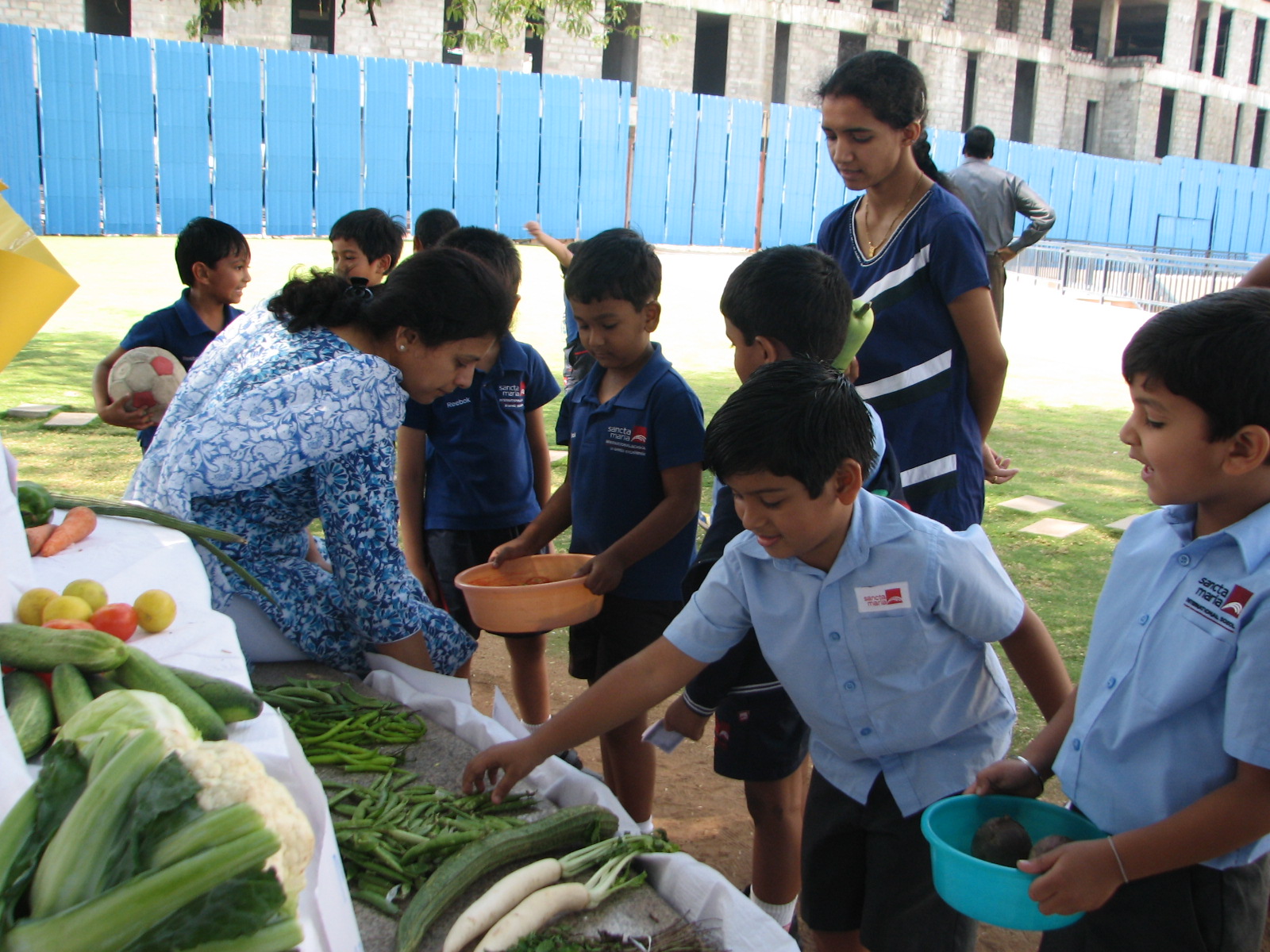
The highlight of all the activities conducted was the vegetable shop. In the play area, we put up a vegetable shop with almost 30 different varieties of vegetables with a price tag on each of them. The children were then given play money for real life experience of vegetable purchases. They were introduced to each and every vegetable with a recap of where each of those vegetables grew. Then they were instructed that they need to buy at least one vegetable from each category like an herb, tree product, underground vegetable etc. The activity further had the children put the ‘purchased’ vegetables in the basket and they had to pay for it. It was an enthralling experience for the children since; each of them experienced the actual ‘purchase’ of the vegetables. This real life ‘simulation’ of vegetable purchase was very engrossing for them, as the children were paired together. One partner was responsible for picking up vegetables by calling out its name loudly and the other partner acknowledging the purchase. Then the second partner was responsible for taking out the play money and paying for the purchased vegetables. This was an absolutely delightful experience for the children as they experienced looking around, calling out the vegetables by name and making the final purchase themselves.

As teachers, the most fulfilling experience for us was to watch the satisfied expressions on the faces of the children after they made the purchase of the vegetables ‘themselves’. They each felt that they had ‘achieved something great in world’ in their little way, by doing ‘real world’ transactions during purchase of the vegetables. The expression on each child’s face itself was perhaps a ‘Kodak moment’. For us, the teachers, these expressions were ‘priceless’. We would love to share with you some of these ‘Kodak Moments’. Trust you will all enjoy seeing these pictures.


-Asha and Rakhi