Monday, March 23, 2015

Women's Day Celebration!

Every year the world has set aside a day to celebrate the woman. We are forced to ask the question, who is a woman? I define a woman simply as:

W – WONDERFUL MOTHER
O – OUTSTANDING FRIEND
M – MARVELLOUS DAUGHTER
A – ADORABLE SISTER
N – NICEST GIFT TO CHILDREN FROM GOD.

Women are great to have and to be. Without them we won’t have got some of the great leaders we have today and even us.

There is an English saying that goes “behind a successful man there is a woman”. This saying sums it up all. But there is something on this my definition of a woman that I want us to look at. The W and the N. This essentially tells us that a woman is also a mother.

I would add parallelly that behind any successful leader there is mother. Mothers have always given impact to great leaders and to society. They mold and carve out society and its leaders. They are the true leaders. It does not surprise me that the vast majority of calls that I receive from my children’s home are from their mothers. Mothers have this instinctive quality to lead children. When I was a kid, I once asked my mother why I studied arithmetic. She said I should look everywhere. Do I see triangles or not? Do I see other shapes too? Do I see numbers in money?  Do I want to be cheated by my siblings when they have to share “pieces of fried chicken” amongst us? I see this response valid to date. It actually lead me to love mathematics and science. Such is the response of a leader. Such is the response of a mother. I would like to tell you a story on the importance of having a mother:

The story starts when a boy meets his mother crying…

Why are you crying, a young boy once asked his Mom one day?

"Because I'm a woman," she told him.


"I don't understand," he said.


His Mom just hugged him and said, "And you never will, but that's O.K.".......


Later the little boy asked his father,

"Why does Mom seem to cry for no reason?".
"All women cry for no reason," was all his Dad could say......

The little boy grew up and became a man, still wondering why women cry.


Finally he put in a call to God and when God got back to him, he asked "God, why do women cry so easily?"


GOD answered.... ..


"When I made woman,

I decided she had to be special.
I made her shoulders
strong enough to carry
the weight of the world, yet,
made her arms gentle enough to give comfort...

I gave her the inner strength

to endure childbirth
and the rejection
that many times will come
even from her own children.

I gave her a hardness

that allows her
to keep going and take care
of her family and friends,
even when everyone else gives up, through sickness and fatigue without
complaining. ...

I gave her the sensitivity to love her children under any and all circumstances. Even when her child has hurt her badly....


She has the very special power to make a child's boo-boo feel better and to quell a teenager's anxieties and fears....


I gave her strength to care for her husband, despite faults and I fashioned her from his rib to protect his heart....


I gave her wisdom to know that a good husband never hurts his wife, but sometimes tests her strengths and her resolve to stand beside him unfalteringly. ...


For all of this hard work,

I also gave her a tear to shed.
It is hers to use
whenever needed and !
it is her only weakness....
When you see her cry,
tell her how much you love her, and all she does for everyone, and even though she may still cry, you will have made her heart feel good.

She is special!


Each day is a mountain that must be climbed; with courage each step gets easier. and that courage is Provided by MOTHER...


Love your Mother Always and keep her Smiling


It was therefore not out of place that our pre-primary Sancta-Marians decided to convert the celebration of the day of the woman to a celebration of the day of their mothers.


It was a day full of fun for our small ones. You could see the smiles on their faces as each of them held their mothers and gently negotiated their way to the open amphi-theatre. They happily danced and the occasion was graced with their smiles and fanfare. All the mothers were present. It was indeed a day for our small ones to be grateful to the women who became their mothers. 

-Mr.Elvis Tachu and Ms. Kavita 

Wednesday, March 4, 2015

A 'Rock'ing Day!

The morning of 27 February started in a different way for the Sancta Marians. As per the routine we have an assembly in our grand Open Air Theatre every Friday. But, on 27 February which was Friday, it was different. All the students were heading towards the old Dining area, and for what? It was for an interesting guest lecture by a grandparent of one of our students, Mr.Ramchander Rao Divi. Mr.Rao graduated from Andhra University, has done his PG from IIT Roorkee and PCH from University of Toranto.

He is a professor of Geology at the University of Kuwait. He has taught at various universities across Saudi Arabia and India.  


For the young students of Sancta Maria, he did an interesting presentation on Minerals and types of rocks. The students were full of curiosity and asked a lot of questions to Mr. Rao. To his surprise, a lot of 2 and 3 graders answered his questions which were of advanced levels. The USP of the presentation was a collection of different rocks that he got with him. He showed us a fossilized bee, estimated age of the same being 15 million years.
Overall, it was an interesting session for the students and they could not keep themselves from discussing about the session for the rest of the day.

-Raksha Lapasya and Letitia 

Sunday, March 1, 2015

Sports Day- A Day for All

A holistic education is one which allows the children to develop all their faculties that place sports and other extra-curricular activities at par with academics. This is especially true in the early years of education, where hand and eye co-ordination, motor skills are of paramount importance.

The Annual Sancta Marian Pre-Primary Sports Day that was held on January 24th, 2015 was aimed at demonstrating the importance of sports in a child’s life. From the Tiny Toddlers of Nursery to the Champions and All Rounders of PP2, all the students of the pre-primary section put together a great show, inviting much cheer from the audience.

The Sports Day began with a walk past by the students holding smiley placards. The nursery students released the balloons as a symbol of declaring the meet open. The walk past was followed by circuit training, which included zig-zig running, jumping hurdles, crawling through the tunnels. These circuit training activities were designed to increase body strength by using high-intensity aerobics. They also are known to improve ocular control, along with concentration levels. Body balancing was another activity our students pulled without ease. The students have been trained to perform these activities throughout the academic year.

To invite audience participation, parents and some daring grand-parents were called upon to participate in a couple race which proved to be a great success. The students also showed off their athletic skills in various races including hurdle jumps and backward racing.  A stunning cheerleading drill, performed by the students of PP2, was waiting to excite the senses of the audience at the end of the day’s events. Colours and gaiety were not the show-stoppers, but our lovely students were.

All our little champions were rewarded with medals and certificates, by a handful of pre-primary parents who had been with us for the longest time. They put together a great feast for the eyes, and won over many a heart at the end of the day.

Thursday, February 19, 2015

Science in Post-Independence India

When the World War II ended in 1945, Germany, Italy and Japan lost and France was badly shaken. Even Britain had suffered tremendous losses and its economy was almost ruined. Thus, the colonial powers which had ruled the world and spread poverty, hunger and disease everywhere, were in no position to suppress people anywhere any more. The constant struggle for freedom in the colonial countries had also reached a high pitch. The result was that, one after another, more than a hundred countries of Asia, Africa and South America became free.

The countries which had become newly independent had the tremendous problem of reconstructing their economy so that tolerable conditions of living could first be created for all their people. The old ruling countries, on the other hand, had to think of ways and means of continuing to drain the wealth of their erstwhile colonies.

Science and technology had to be deliberately employed by both sets of countries. The only difference was that the developing countries had to make a start from scratch-with hardly  any  institutions  or  people  who  could  engage  in  competitive  science  and technology, whereas the advanced or developed countries now had a stronger base of science and technology than ever before.

The Indian freedom movement had been conscious that political independence was only a stepping stone to economic independence. Our leaders had realised that our decisions about industry and trade would have to be taken by us alone without compulsion of foreign governments or their business counterparts. And that our economic development would have to serve the people and meet the minimum needs of their food, health, shelter, education, culture etc.

The role of science and technology was crucial for this endeavour and this was clearly expressed in the "Scientific Policy Resolution" adopted by the Parliament in 1958. This resolution was drafted and piloted through the Parliament by our first Prime Minister, Jawaharlal Nehru. In the words of this Resolution:

The key to national prosperity, apart from the spirit of the people, lies, in the modern age, in the effective combination of three factors, technology, raw materials and capital, of which the first is, perhaps, the most important, since the creation and adoption of new scientific techniques can, in fact, make up for a deficiency in natural resources, and reduce the demands on capital. But technology can only grow out of the study of science and its applications.
Since  Independence,  and  particularly  after  the  passage  of  the  Resolution,  a  great expansion of science and technology in both education and research has taken place. The situation today is far different from what it was in 1947. We have now about  290 state public universities, 42 central universities, 50 deemed universities, 17 Indian Institutes of Technology, over 2000 engineering colleges and  150  medical  colleges,  a  few  hundred  scientific  research  laboratories  under  the Central and State governments, as also R&D units in private industry. Research is king done in almost all areas of modern science. The conspicuous success of our scientists in atomic energy, space research and agriculture is well known.

The funds allocated to research have also vastly increased over what they used to be 65 years ago. But in the modern world, it is not enough to be in the forefront of creative science or innovative technology. Out of the total world expenditure on research, excluding  the  socialist  countries,  98%  is  spent  by  the  developed  countries,  the  old imperial powers. Only 2% is spent by all the developing countries taken together. In this, India's share may be half a per cent. New discoveries and new inventions, therefore, still come from the advanced or developed countries.

Surely, this is neither a happy situation nor a stable one. The power of science has reached such a pitch that international relations have to be readjusted, and national effort has to be recast so as to bring about the benefits of science to the lives of common people.

-Hanmanthu and Pranitha

Wednesday, February 18, 2015

Scroll Painting

In India we have a rich culture in all aspect, like fine arts, theater arts, folk arts or in Martial arts but today we have to focus on  Indian Scroll painting. Though the Far eastern scroll paintings are also famous, like Chinese scroll & Japanese scroll paintings,

In India scroll paintings are famous in Bengal, Orissa, Telengana. In Bengal and Orissa it’s call patachitra painting and in Telengana it is call Cheriyal painting.

Now the question is, what is scroll paintings? 

Scroll paintings are the narrative story telling with the help of painting and singing. They start the story and unroll it in opposite direction til the story end.  

Kalighat painting


In west Bengal a traditional caste community of artists, called patuas. The kalighat patachitra is till famous but in modern time there is non of  the patuas are found in the kalighat area. They are scattered in Midnapur, Birbhum, Bankura  and puruliya districts in Bengal and there they continue with the patachitra painting.


They paint colourful scroll to accompany songs which they sing to relate historic, current and religious event. Past they traveled long distance to perform and singing the songs and unrolling the scrolls panel by panel but in modern time they are struggling to compete with the  other modern entertainment forms, such as cable TV, movies etc.

 In Orissa scroll painting is called “Pattachitra”and it is a traditional painting.


The story-based on Hindu mythology and specially inspired by Jagannath and Vaishnava cult.Itis a oldest art form and also most popular art forms of Odissa. In Sanskrit word patta meaning canvas and chitra meaning picture. This art form is more than thousand years old. The use of colour application is rich, creative motifs and design and also portrayal of simple themes, Mostly mythological in depiction. The centre of this painting is Puri, Konarkand Bhubaneshwar region. The best works are done in around Puri, especially in Raghurajpur village. In this village almost each and every body is an artist. Except this Paralakhemundi,Chikiti and Sonepur is also known for pattachitra paintings. 
We can see the mix style of folk and classical  elements in Orissa’s scroll painting. The dress style is shown Mughal influence. The lines are bold , clean , sharp and also angular. Basically in the painting there is no perspectives and no landscapes on the back ground, all the incidents are seen in close juxtaposition. The back ground is shown with floral motif and foliage mostly red in colours...it’s a mixture of design and figurative forms.

On the other side Cheriyal scroll painting is a stylized version of Nakashi art. Like the two other scroll painting this is also a narrative format, most like a flim or comics strips.this is Influence from Telengana region  local motifs. The stories are mostly from Puranas and epics. 


Like all the above said scroll paintings it is also face competition from TV, coumpturMovies too. This  painting is  presently made only in Cheriyal, warangal district of Telengana. The  balladeer community known as Kaki Padagollu are involve of the story telling. They display the scroll and accompanied by music and dance went from village to villageBased on the story of Indian epics and Puranas. In their five member team, two people would narrate the story and rest others accompanied by music, such as harmonium, tabla and castanets. The  scroll would flow like a film roll.

The size of the scroll is 3 feet in width and went 40-45 feet in length, it depending on the story. The traditional scrolls are mostly vertical format but illustrating stories in a series of horizontal format. A floral border in the middle separates the two panels. The scroll have at least fifty panels.
At the end I can say that we have to encourage   the artist to buy some of their works when ever we meet them. This is the way we can save the ancient folk art of India.  

-Mousumi and Sukalyan

Sunday, February 8, 2015

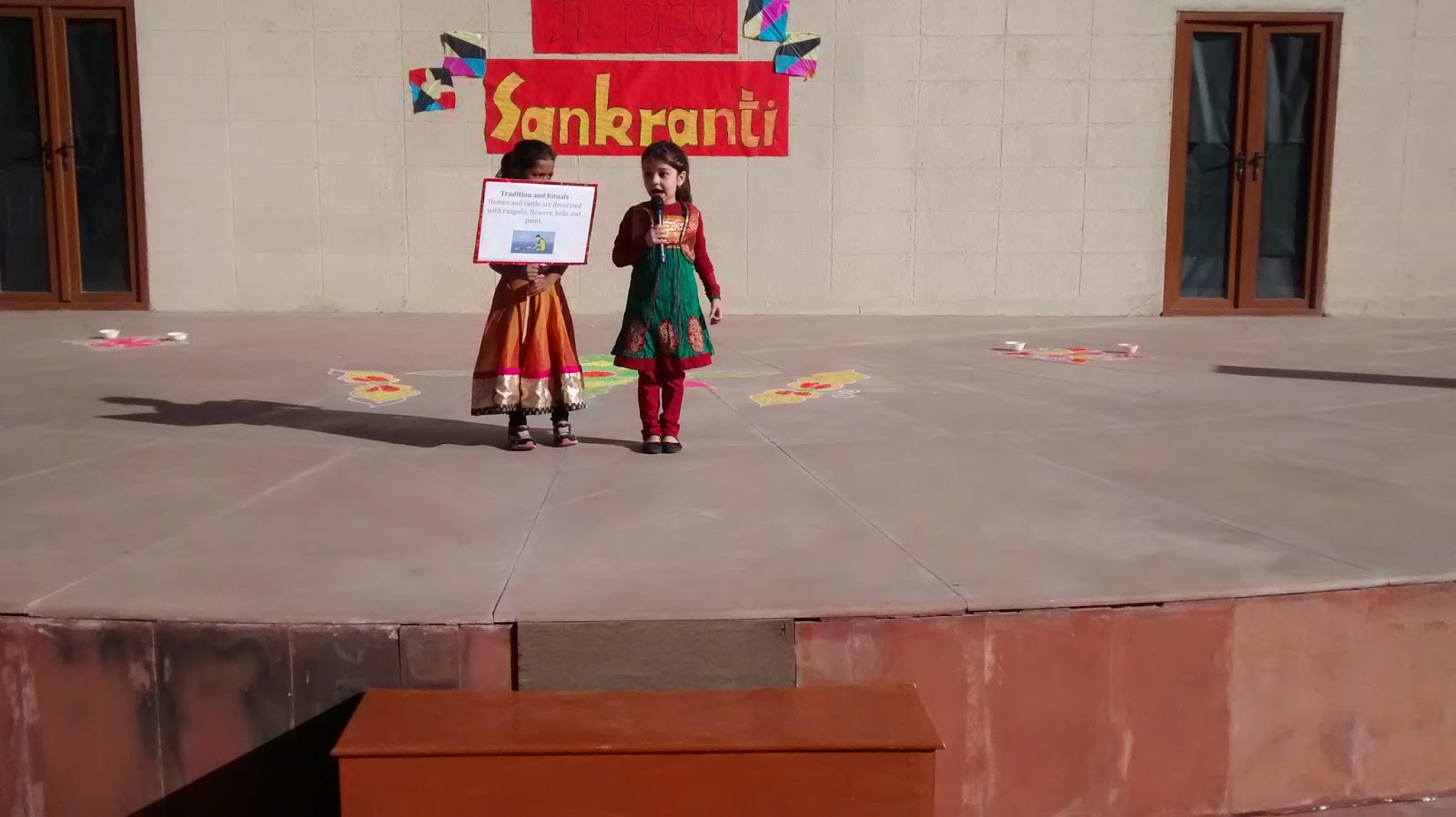
Sankranti @ Sancta Maria!

The pre-primary section ushered in the new year with a special assembly dedicated to Sankranti, on 12th January, a week after the re-opening of the school. The students, decked in traditional attire, were excited to learn more about the festival. 


 Students of PP2 performed a skit on the rituals and festivities of the Sankranti season. PP1 students mesmerized the audience with a unique performance of telugu folk song and dance. The nursery students also joined them to add more colour to the performance. Later in the day, the students indulged in decorating corridors using vibrant rangoli patterns. The afternoon brought an end to the celebration, with kites of all shades soaring high and bringing smiles to many flushed faces.


Spring time – All about plants - Why? What? and How?

Allowing children to explore the natural world provides a multitude of learning opportunities—from building observation and problem solving skills to encouraging physical activity.


Is plant a living thing? Needs of a plant? Parts of a plant? Uses of a plant? Types of plant?

Yes, we discussed all of that with our kindergarteners. To sum up all of it there would not be a better place to tour than a horti expo organized for the first time in necklace rd, the heart of the city of Hyderabad. Besides our field trip to the KBR park and the zoo, this was our third trip.


A warm friday morning filled with a breath of fresh air, we started off our trip to this world of plants.  It was an awe inspiring visit for the little ones. We visited stalls filled with vegetables, fruits, flowers, seeds, plant products and many more. There were stalls for flowering plants, desert plants, saplings, ornamental, seeds, fruit and vegetable plants. Climbers, creepers, shrubs, bushes and trees. They explored them all. The expo turned out to be more than a visual treat to their curious minds.


It was a unique opportunity for the teachers to expand the walls of our classroom and inspire our students to gain a curiosity about and an understanding of the role of plants in our daily lives.  


- Kamala Manda